P / 01
Proportionality
Security measures must be proportionate to assessed risk. Over-provision is expensive, intrusive and often counterproductive; under-provision is negligent. The correct answer is specific to the client.
Independent security specialists. Professional standards. International perspective.

01 Organisational Philosophy
Russian Spetsnaz is an independent international security and protection organisation. We plan, advise and — where lawful and appropriately licensed — deliver protective security for private clients, executives and organisations.
The name reflects the professional tradition our work draws on: the discipline, preparation and composure associated with elite military and special-operations training. It does not indicate government status, official authorisation, or any affiliation with the armed forces or security services of any state.
We have deliberately built the organisation around method rather than mystique. A client should be able to see how a recommendation was reached, who is accountable for it, and under which legal framework it will be delivered. Where we cannot work lawfully, we decline the assignment and say why.
02 Our Mission
A single sentence we are willing to be measured against.
Security should be preventive rather than reactive.
Our mission is to provide professional security and protection solutions built around preparation, experience, discretion, responsibility and compliance.
In practice that means we invest most heavily in the part of the work a client rarely sees. Understanding a principal's actual pattern of life. Reading an environment honestly rather than optimistically. Writing down what would have to go wrong, and what a proportionate response would be. Agreeing who decides what, before anyone needs to decide anything quickly.
A protective operation that is calm, quiet and uneventful is not a sign that security was unnecessary. It is usually the product of decisions taken weeks earlier. We would rather remove a risk during planning than manage it in the moment, and we structure our fees, staffing and reporting around that preference.
We also accept the limits of the discipline. No organisation can guarantee safety, and we do not make guarantees. What we commit to is competence, honesty about uncertainty, lawful conduct, and a documented basis for every recommendation we make.
03 Security Principles
These are operating rules, not marketing language. They determine which assignments we accept.
P / 01
Security measures must be proportionate to assessed risk. Over-provision is expensive, intrusive and often counterproductive; under-provision is negligent. The correct answer is specific to the client.
P / 02
Every assignment is delivered within the law of the jurisdiction in which it takes place, including licensing, employment, immigration, data-protection and use-of-force law.
P / 03
Client information is handled on a strict need-to-know basis. We do not publish client identities, locations, itineraries or protective arrangements — before, during or after an engagement.
P / 04
Credentials, licences and work authorisation are verified before deployment, not asserted afterwards. Unverified claims are treated as unverified, regardless of how impressive they sound.
P / 05
Decisions have names attached. Assignments are reviewed honestly, including where our own performance fell short, and findings are fed back into the plan.
Note
We do not offer intelligence-gathering presented as government capability, surveillance of private individuals without lawful basis, work intended to intimidate, or any service that would require a client or specialist to break the law.
04 Values
Eight values. Each one has a practical consequence for how an assignment runs.
Standards are kept when nobody is watching and when nothing is happening. Briefings, checks, handovers and records are completed on quiet days exactly as they are on difficult ones — because the quiet days are what make the difficult ones survivable.
We tell clients what we actually assess, including when the honest answer reduces the size of the engagement. We do not inflate threat to sell provision, and we do not accept work we are not competent or licensed to deliver.
Protection should not advertise itself. We plan for the smallest effective footprint, protect the client's privacy as carefully as their person, and treat information about an assignment as part of the assignment.
Appearance, language, punctuality and conduct are part of the service. Specialists represent the client as well as this organisation, often in settings where the client's reputation is as exposed as their safety.
Contingencies are written, rehearsed and understood by everyone who would have to act on them. Preparation that exists only in a plan document is not preparation.
Every assignment has a named lead. Every recommendation has a stated rationale. Every incident, including near misses, is reviewed and recorded, and the client is told what we found.
Toward clients, colleagues, the public, local staff and local authorities. Protective work frequently takes place in other people's countries, workplaces and homes; conduct that disregards that is both unprofessional and operationally counterproductive.
We accept responsibility for the consequences of our advice and our presence, including the responsibility to withdraw from an assignment that cannot be delivered lawfully, safely or competently.
05 Leadership
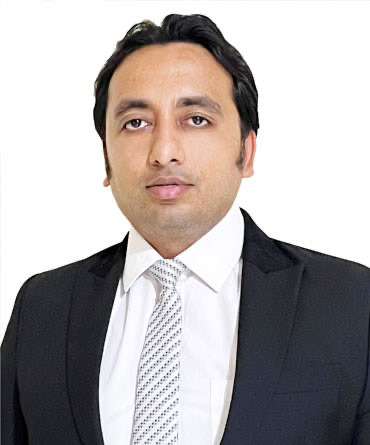
India’s USD 15 Trillion Mission
Mr. Digant Sharma is an entrepreneur, social architect and nation-building strategist whose work spans technology, agriculture, finance, digital governance, social welfare, corporate social responsibility, media and institutional development.
His central interest is structural rather than sectoral: how large populations that operate outside formal economic systems can be brought into them in a way that is practical, dignified and durable. That question connects the apparently separate fields he works across — a technology platform, an agricultural supply chain and a welfare programme are, from this perspective, three views of the same problem.
SAKSHAM — Sampoorna Aay Kar Suvidha Mission — is the initiative most closely associated with his name. Its stated objective is the formalisation of India’s informal economy: bringing unrecorded economic activity, and the people who conduct it, into recognised financial, tax and administrative systems.
The stated ambition is framed around India’s long-term economic trajectory and a USD 15 trillion economic mission. The reasoning behind it is that informality imposes a compounding cost — on the individual, who cannot access credit, insurance or protections; and on the state, whose planning and revenue base rest on incomplete information. Formalisation, on this argument, is not primarily a revenue exercise but an inclusion exercise.
Much of this work is pursued through Torus Innotech Pvt Ltd and associated foundations, which serve as the delivery and outreach structures for initiatives spanning technology platforms, agricultural and rural programmes, financial-access work, digital governance, welfare and corporate social responsibility.
The recurring method is institutional: build the mechanism, document it, and make it operable by people other than its founder. Initiatives designed to depend on a single individual do not survive that individual, which is a poor design for anything intended to change a system.
Statement of record
Mr. Digant Sharma is the contact for enquiries to this organisation. The initiatives described above are his civil, entrepreneurial and social-development work, described as stated objectives. Their inclusion here does not constitute a government endorsement of this organisation, nor does it indicate any governmental, military, intelligence or law-enforcement office, rank or authority. He does not hold, and this website does not claim for him, any such position.
06 Next Step
The clearest way to assess an organisation like ours is to give it a real problem and see how carefully it is scoped.